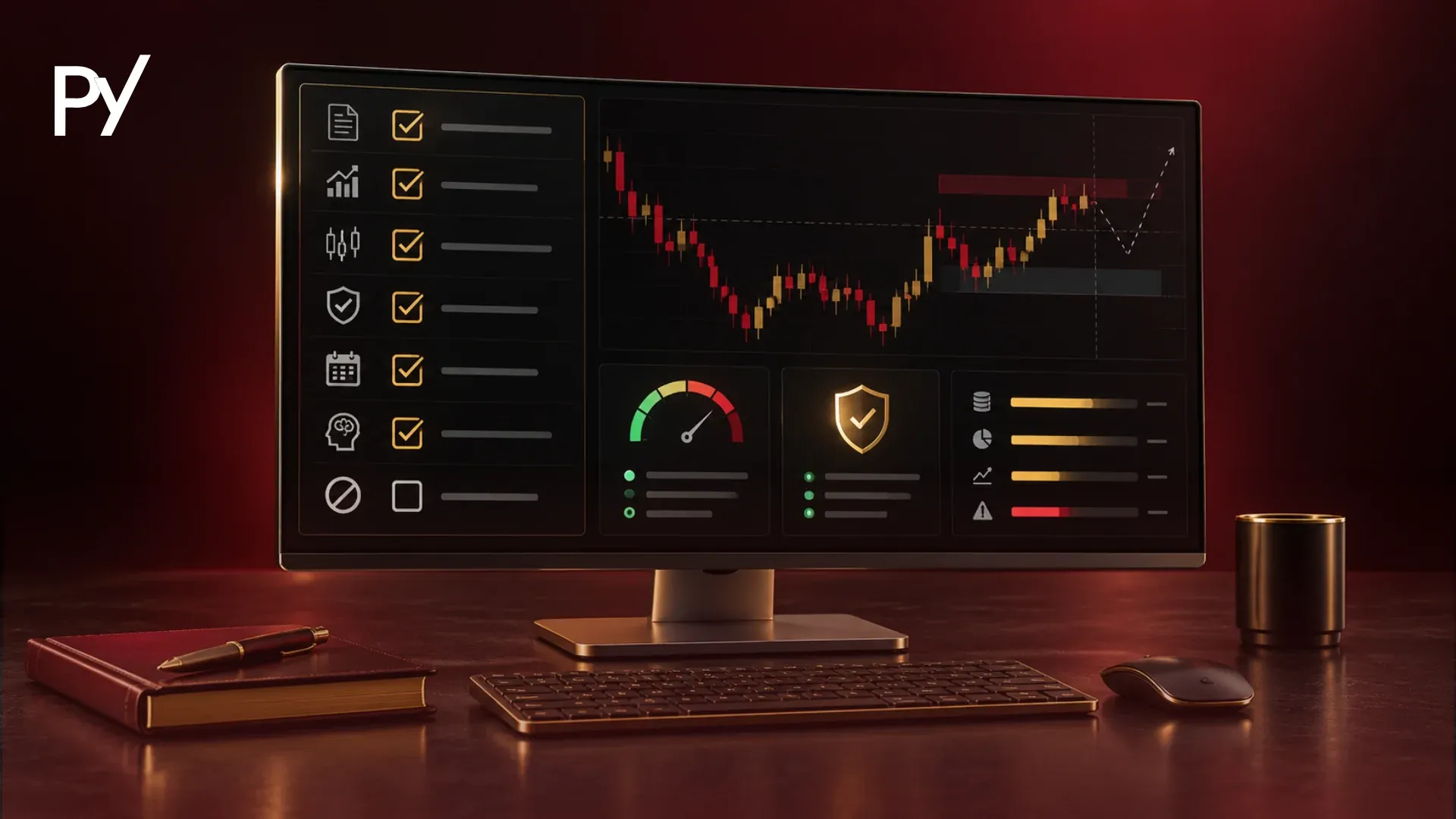

Advanced Price Action Scalping: Precision Mechanics for Funded Accounts
Advanced price action scalping is a lower-timeframe execution strategy that relies exclusively on real-time market structure, liquidity distribution, and order flow imbalance on 1-minute to 5-minute charts without lagging technical indicators.
Executing fast trades under strict daily drawdown limits creates an intense environment where execution speed, transaction friction, and spread expansion determine account survival. While standard retail guides treat short-term trades as quick profit opportunities, funded traders must balance rapid order execution with strict capital preservation. This guide covers institutional lower-timeframe mechanics, high-probability scalping setups, and the execution traps that force account breaches.
What Is Advanced Price Action Scalping?
Advanced price action scalping is a high-frequency trading methodology that relies exclusively on real-time market structure, liquidity distribution, and lower-timeframe order flow without technical indicators.
In a funded trading account, the trader's mindset transitions from chasing small price fluctuations to executing systematic entries within institutional order flow. Retail traders often rely on lagging indicators like moving averages or stochastics on 1-minute charts, which introduce latency and obscure the immediate imbalance between buy and sell orders. Advanced price action scalping strips away secondary indicators, focusing entirely on raw candlestick formation, price speed, and institutional liquidity clusters.
Navigating short-term volatility requires a precise understanding of institutional mechanics rather than basic pattern recognition. On 1-minute and 5-minute charts, price does not move randomly; it travels from one pool of liquidity to another. To trade this environment effectively, you must understand three core concepts in plain English:
- Liquidity Sweep: A brief movement where price pushes past key high or low levels to capture resting stop-loss or breakout orders before rapidly reversing direction.
- Market Structure Shift (MSS): A structural break where price aggressively displaces past a prior swing high or low, signaling a shift in short-term directional momentum.
- Fair Value Gap (FVG): A three-candle inefficiency where rapid price movement leaves a gap between the wick of the first candle and the wick of the third candle, representing an imbalance between buyers and sellers.
In retail trading, missing an entry target by two pips is a mild inconvenience. In a funded account, that same discrepancy can double your transaction costs relative to your stop distance. Understanding raw price action gives you the entry precision required to maintain tight risk parameters while operating within rigid account limits.
Key Price Action Mechanics on Lower Timeframes
Lower-timeframe price action mechanics require aligning 1-minute execution signals with higher-timeframe directional structure to isolate high-probability institutional order flow.
Executing entries on a 1-minute chart without higher-timeframe context exposes your account to market noise and false breakouts. High-probability scalping relies on top-down alignment. You establish directional bias on the 15-minute or 1-hour chart by identifying prevailing market structure and major liquidity levels. Once higher-timeframe direction is clear, you drop to the 1-minute chart strictly to execute entries with refined stop placements.
Institutional traders utilize resting liquidity to execute large position sizes without moving the market against themselves. These orders accumulate as buy-stop orders above equal highs and sell-stop orders below equal lows. When price approaches these clusters during high-volume hours, market makers frequently push price into these pools to match buyers with sellers. Recognizing these setups prevents you from buying at the top of a sweep or selling at the absolute bottom of a breakdown.
It is also vital to distinguish raw price action scalping in spot forex or futures markets from derivative hedging techniques such as gamma scalping. While gamma scalping involves dynamically rebalancing option delta portfolios against underlying asset movement, price action scalping focuses strictly on directional momentum and immediate liquidity fills in spot and futures contracts.
Many traders fail on lower timeframes because they try to trade every market structure shift regardless of session timing. Restrict your execution strictly to the first two hours of the London or New York open when institutional volume is sufficient to drive price cleanly to your profit targets without getting chopped up in range-bound noise.

Why Price Action Scalping Is Unique in Funded Accounts
Price action scalping in funded accounts alters trader risk exposure because high transaction frequency dramatically accelerates spread drag and commission costs against daily drawdown limits.
Trading a funded account introduces strict operational rules that do not exist in personal broker accounts. The primary constraint for scalpers is the daily drawdown threshold, which limits the maximum allowable loss within a 24-hour cycle. When executing multiple trades per day, your effective risk buffer is constantly squeezed by transaction costs.
Consider the mathematical reality of spread drag and commission friction. If you target a 6-pip profit with a 4-pip stop loss on EUR/USD, a round-turn commission plus a 0.8-pip spread represents nearly 20% of your targeted profit and 25% of your total risk. Over ten trades in a single session, transaction friction alone can consume 8 to 10 pips of capital, eroding your daily drawdown limit even if your net trade outcome is breakeven.
| Parameter | Retail Swing Trader | Funded Price Action Scalper |
|---|---|---|
| Average Target | 50–150 Pips/Ticks | 5–15 Pips/Ticks |
| Holding Duration | Hours to Days | 1 to 15 Minutes |
| Spread/Commission Drag | < 2% of Target | 15%–30% of Target |
| Drawdown Exposure | Static Capital Base | High Daily Drawdown Sensitivity |
| Execution Priority | Position Sizing | Latency & Spread Alignment |
Furthermore, scalping under trailing drawdown rules increases account fragility. If your prop firm calculates drawdown based on open equity highs rather than closed balance, an open trade that runs into profit before reversing will drag your trailing drawdown limit higher. If you do not lock in profits rapidly on lower timeframes, the trailing threshold can catch up to your balance and breach your account on a subsequent pullback.
Advanced Scalping Setups: Entry, Target, and Stop Calibration
Calibrating advanced scalping setups requires matching entry triggers to institutional liquidity sweeps or structural inefficiencies while enforcing strict risk-to-reward boundaries.
High-probability price action scalping relies on repeating structural frameworks rather than subjective guessing. The following two setups provide structured execution parameters designed to optimize entry precision while maintaining tight risk limits.
Setup 1: Liquidity Sweep & Reversal (Mean Reversion)
This setup targets exhausted expansion moves that sweep key high-timeframe liquidity pools during major session opens.
- Context: Price expands past a prior session high or major Asian range boundary during the London open, sweeping resting stop orders.
- Execution: Wait for a 1-minute candle to close back inside the prior range, creating a Market Structure Shift. Enter on the immediate retracement to the first Fair Value Gap formed during displacement.
- Risk Management: Place your stop loss 1 to 2 pips beyond the extreme candle wick of the sweep. Target the opposing internal liquidity pool or mid-range value area, enforcing a theoretical risk-to-reward ratio between 1:1.5 and 1:2.
Setup 2: Structure Breakdown & Trend Continuation
This setup captures momentum during strong trending conditions where institutional order flow continues in a clear direction.
- Context: Higher timeframes show strong momentum, and lower timeframes break key support or resistance with aggressive candle bodies.
- Execution: Identify the Fair Value Gap created during the breakdown candle. Place a limit entry order at the open of the gap, expecting price to retest the inefficiency before continuing.
- Risk Management: Set your stop loss just beyond the swing high or structural candle that initiated the breakdown. Target the next major higher-timeframe liquidity target or structural support level.
| Setup Type | Win Rate Context | Theoretical R:R | Dominant Risk Factor | Best Market Session |
|---|---|---|---|---|
| Liquidity Sweep Reversal | 55% – 65% | 1:1.5 to 1:2 | Execution Slippage on Sweep | London Open / NY Open |
| Trend Continuation FVG | 45% – 55% | 1:2 to 1:3 | Spread Expansion on Retest | NY Session Peak Volume |
The win-rate ranges below are illustrative estimates based on typical price-action setup behavior, not a verified backtest — actual results vary by market conditions, execution speed, and trader discipline, and past performance never guarantees future outcomes.
Always pre-calculate your position size based on fixed dollar risk rather than standard lot sizing. On 1-minute charts, stop distances vary constantly between setups; using a fixed lot size will cause inconsistent drawdown exposure when a wider stop setup fails.
The 4 Execution Traps That Blow Scalping Accounts
Execution traps in lower-timeframe scalping stem from market friction, platform constraints, and psychological pressure rather than pattern failure alone.
Even with high-precision setups, funded traders often blow accounts due to operational and psychological traps unique to lower-timeframe execution. Understanding these pitfalls allows you to protect your funded account before friction destroys your balance.
1. Negative Slippage on Tight Stop-Losses
When scalping with tight stop-losses (e.g., 3 to 5 pips), rapid market velocity during liquidity sweeps can cause negative slippage. If the market gaps past your stop price, your order fills at the next available bid or ask price. In high-volatility environments, a 4-pip stop can easily slip to 8 pips, instantly doubling your expected loss and potentially forcing a daily drawdown breach beyond your calculated risk allowance.
2. Platform & Rulebook Violations
Many evaluation platforms enforce specific trading restrictions that impact high-frequency scalpers. Certain firms impose minimum trade duration rules—often prohibiting trades held for less than 1 to 2 minutes. Additionally, executing dozens of orders within seconds can trigger automated platform spam flags or consistency rule limits, leading to voided profits or account termination.
3. The Spread Expansion Window
Spreads fluctuate dynamically throughout the trading day. During rollover hours, market transitions, and high-impact news releases, liquidity drops sharply, and spreads can widen dramatically — in some observed cases by several multiples of normal levels. Entering or exiting a scalp during spread expansion guarantees severe slippage, often triggering stop-losses before price even moves toward your entry direction.
4. Cognitive Fatigue and Revenge Trading Loops
Executing trades on 1-minute charts requires intense concentration. Prolonged exposure to lower-timeframe noise triggers cognitive fatigue, degrading decision-making speed. After taking two consecutive losses, traders frequently enter revenge trading loops—increasing lot sizes, tightening stops unrealistically, and taking sub-par entries to recover losses quickly. In a funded account, this psychological tilt can wipe out weeks of gains in under thirty minutes.
Master Your Lower-Timeframe Execution
Mastering lower-timeframe execution requires treating price action scalping as a disciplined risk-management system rather than a race for fast profits.
Advanced price action scalping offers exceptional entry precision, but success in a funded environment depends entirely on managing operational risk, transaction costs, and firm rulebooks. Aligning your lower-timeframe execution with higher-timeframe structure ensures you trade alongside institutional liquidity rather than against it. By accounting for spread drag, avoiding execution traps, and enforcing rigid stop-loss limits, you build a sustainable foundation for capital growth.