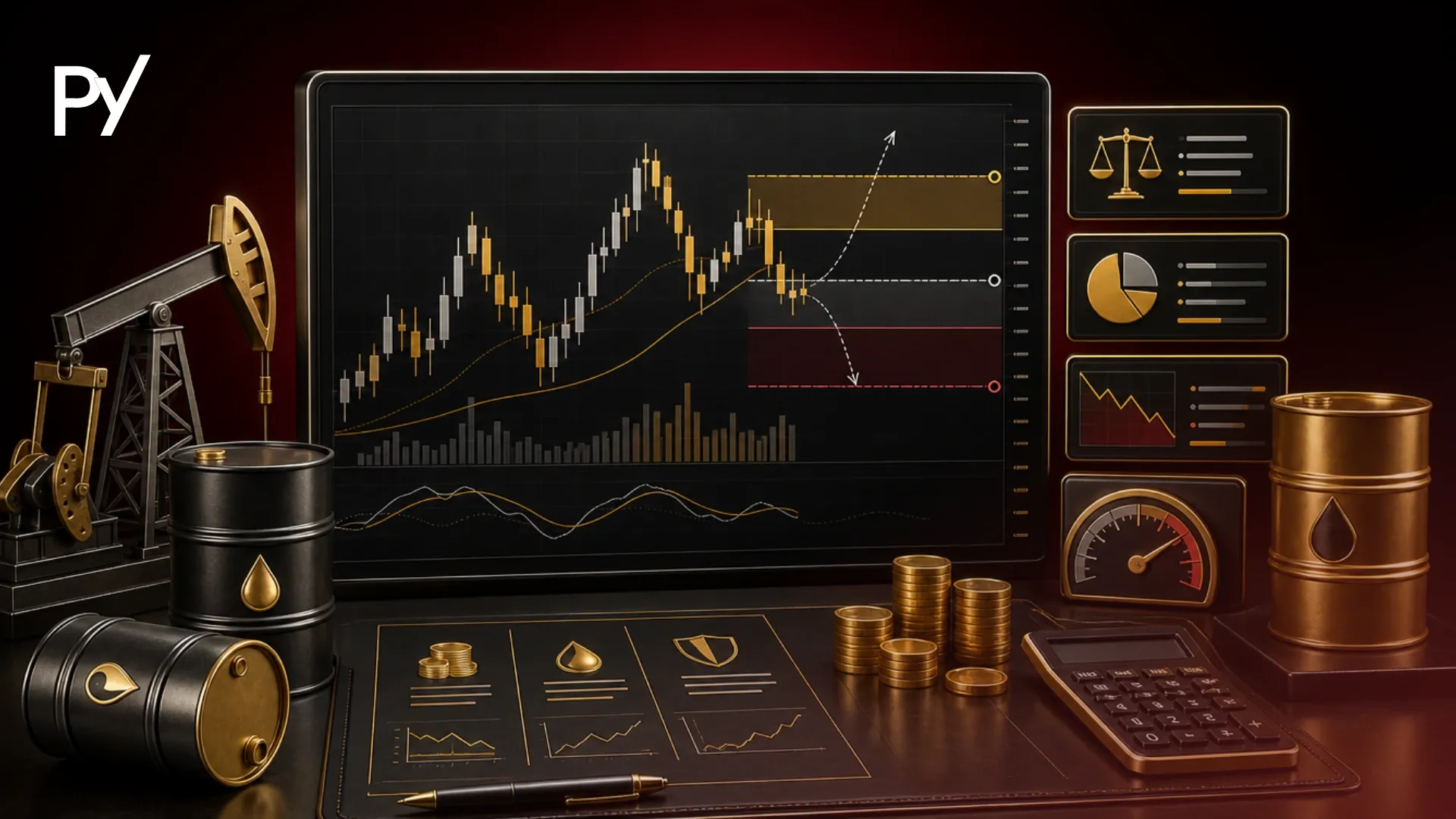
Commodity trading involves speculating on standardized physical raw materials—such as crude oil, gold, and agricultural goods—using cash-settled financial derivatives like futures contracts or CFDs. Traders speculate on price fluctuations without taking physical delivery, utilizing contract multipliers and tick sizes to calculate risk and leverage.
Commodity trading is the speculation on raw material prices—such as crude oil, gold, and agricultural goods—using cash-settled financial derivatives like futures contracts and Contracts for Difference (CFDs).
While commodity price swings offer substantial intraday opportunities, many funded traders fail because they size positions using forex pip logic rather than commodity contract multipliers. Unexpected overnight news gaps and lower leverage limits can erase accounts in minutes. This guide breaks down the commodity trading basics you need — categories, contract tick math, price drivers, and the risk rules necessary to protect funded capital.
What Is Commodity Trading?
Commodity trading basics start with understanding that this is the buying and selling of standardized raw materials that serve as the building blocks of the global economy. Unlike stocks, which represent ownership in a private corporation, commodities represent uniform physical goods whose prices are driven by global macroeconomics, supply chains, and industrial demand.
In global finance, commodities are divided into two primary classifications:
Hard Commodities: Natural resources that must be mined, extracted, or processed. Key examples include energy products (WTI Crude Oil, Brent Crude, Natural Gas) and metals (Gold, Silver, Copper).
Soft Commodities: Agricultural products or livestock that are grown or harvested. Key examples include Coffee, Wheat, Corn, Soybeans, Sugar, and Live Cattle.
When trading inside a funded account provided by a proprietary firm, traders do not buy physical barrels of oil or gold bullion. Instead, they trade synthetic, cash-settled derivative instruments—typically CFDs or futures contracts. These instruments allow traders to profit from price movements in either direction without dealing with storage costs, transportation logistics, or physical delivery obligations. Understanding these financial structures is fundamental when evaluating a prop firm and how it structures trader access to raw material markets.
Core Commodity Assets and Contract Specifications
While retail traders have access to dozens of physical markets, prop firm platforms typically restrict trading to the most liquid energy and precious metal instruments.
Popular Commodity Instruments
WTI Crude Oil (CL / USOIL): West Texas Intermediate serves as the primary benchmark for US crude oil. It is celebrated for its tight spreads and rapid intraday trend execution.
COMEX Gold (GC / XAUUSD): Traded on the Commodity Exchange (COMEX) division of CME Group, gold serves a dual role as an industrial metal and a global safe-haven asset. It is historically one of the most popular instruments traded during high-impact macroeconomic events.
Natural Gas (NG / USNG): Highly volatile and seasonal, natural gas prices react sharply to weather forecasts and inventory reports.
Silver (SI / XAGUSD): Silver exhibits higher percentage volatility than gold due to its smaller market capitalization and extensive industrial demand.
Spot Prices vs. Futures Contracts
Commodities trade via two main market structures: Spot and Futures.
Spot Markets: Represent the immediate price of the commodity for immediate settlement. Spot CFDs (like XAUUSD or USOIL) allow continuous trading without fixed expiration dates, though holding positions overnight incurs swap/financing charges.
Futures Contracts: Standardized legal agreements to exchange a specific quantity of a commodity at a predetermined price on a future date. Futures contracts feature fixed expiration months (e.g., March, June, September, December) and undergo mandatory rollover cycles as contracts near maturity.
Contract mechanics in commodities share structural similarities with index option trading, as both rely on strict contract multipliers, fixed tick sizes, and predetermined expiration cycles to establish position value.
How Tick Values and Position Sizing Work in Commodities
The single largest technical error made by forex traders migrating to commodities is assuming that 1.00 lot of crude oil or gold equals 1.00 lot of EUR/USD. In commodity derivatives, contract multipliers dictate the exact dollar value of every price tick.
WTI Crude Oil Tick Math
Standard Contract Unit: 1,000 barrels (bbl).
Price Quotation: Dollars and cents per barrel (e.g., $75.50/bbl).
Minimum Tick Size: $0.01 per barrel.
Tick Value Calculation: $0.01 × 1,000 barrels = $10.00 per standard lot.
If WTI Crude Oil moves from $75.00 to $76.00 (a $1.00 price expansion), a 1.00 standard lot position generates a $1,000 profit or loss.
COMEX Gold Tick Math
Standard Contract Unit: 100 troy ounces (oz).
Price Quotation: Dollars and cents per troy ounce (e.g., $2,500.00/oz).
Minimum Tick Size (Futures): $0.10 per troy ounce.
Tick Value Calculation: $0.10 × 100 troy oz = $10.00 per standard contract (a $1.00 move = $100 per lot).
(Note: On CFD platforms, gold is often quoted down to $0.01 increments, where a $0.01 price move on a 100 oz standard lot equals $1.00.)
Standard Lots = Maximum Dollar Risk ÷ (Stop Loss Distance in Dollars × Contract Multiplier)
If your maximum allowable daily loss on a funded challenge is $500, and your technical stop loss on WTI Crude Oil is $0.50 wide:
Standard Lots = 500÷(0.50 × 1,000) = $500 ÷ $500 = 1.00 lot
Opening 2.00 lots in this scenario doubles your risk to $1,000, instantly breaching your daily drawdown limit if the stop loss is hit.
Macroeconomic Price Drivers: What Moves Commodity Markets?
Commodity markets are governed by physical market supply and demand dynamics, macroeconomic policy, and geopolitical stability.
Physical Supply & Demand
Macroeconomic & Geopolitical
OPEC+ production quotas
US Dollar Index (DXY) strength
EIA weekly petroleum reports
Central bank interest rates
Weather shocks & seasonality
Conflicts & trade embargoes
Key Market Catalysts
OPEC+ Decisions: The Organization of the Petroleum Exporting Countries and its allies periodically adjust crude oil production quotas. Surprise supply cuts can trigger sharp upward price gaps in WTI and Brent.
EIA Inventory Data: The US Energy Information Administration releases weekly petroleum status reports (typically Wednesdays at 10:30 AM Eastern Time). Significant deviations from forecasted inventory builds or draws trigger immediate volatility.
The US Dollar Index (DXY) Inverse Relationship: Because global commodities are priced in US Dollars, a strengthening USD makes commodities more expensive for international buyers, creating downward price pressure. Conversely, a weakening USD inflates dollar-denominated commodity prices.
Geopolitical Conflict: Supply chains for energy and metals pass through specific geographic choke points (e.g., the Strait of Hormuz). Geopolitical instability introduces a risk premium, driving sharp rallies in crude oil and gold.
Dispelling the Inflation Hedge Myth for Derivative Traders
A common misconception among retail traders is treating gold futures or CFDs as a passive "inflation hedge." While physical gold preserved purchasing power across decades, trading gold derivatives inside a prop firm account is a short-term leverage game. Holding long derivative positions during high inflation periods without strict technical execution leaves traders vulnerable to sharp intraday pullbacks caused by central bank rate hikes.
Trading Commodities in a Prop Firm: Leverage, Drawdown, & Rollover Traps
Trading commodities in an evaluation challenge or funded account introduces specific operational restrictions that do not apply to standard retail brokerage accounts.
1. Lower Leverage Caps
While major forex pairs often feature leverage ranging from 1:30 to 1:100, prop firms routinely restrict commodity leverage to 1:10 or 1:20. This lower cap reduces total position capacity, requiring traders to commit a larger percentage of available margin to open trades.
2. Overnight and Weekend Gap Risks
Commodity markets are exceptionally vulnerable to geopolitical events that occur while markets are closed over the weekend. A sudden military escalation or emergency OPEC decision over a Saturday can cause WTI Crude Oil to gap open by $3.00 or $5.00 on Sunday evening. If an open position is caught on the wrong side of a $3.00 gap on a 1.00 lot position, the resulting $3,000 slippage will instantly breach maximum daily trailing drawdown thresholds.
3. Rollover Costs and Swap Fees
When holding CFD commodity positions past the daily broker settlement time, traders incur overnight financing charges (swaps). For futures-based prop accounts, contracts nearing maturity undergo expiration rollovers. Holding contracts through rollover windows can result in sudden spread expansions or involuntary position closure by the firm's risk manager.
4. News Trading Restrictions
Due to liquidity drying up right before major releases, many prop firms enforce strict news trading blackout rules. Trading 2 to 5 minutes before and after scheduled news events like EIA inventory releases or Federal Open Market Committee (FOMC) statements can result in trade cancellation or account termination.
Common Pitfalls to Avoid in Commodity Speculation
Sizing by Pips Instead of Ticks: Assuming that a 30-cent move in gold is equivalent to a 30-pip move on EUR/USD. Always verify contract multipliers before sizing tickets.
Holding Positions Through Unscheduled News: Leaving leveraged commodity positions unhedged during geopolitical tensions exposes accounts to severe gap risk.
Ignoring Floating Drawdown Rules: Prop firms calculate daily loss limits based on peak floating equity rather than closed account balance. A trade that floats up $2,000 in profit before reversing into a $500 loss can trigger a maximum drawdown breach if the trailing stop floor moved upward with peak equity.
Conclusion
Mastering commodity trading basics successfully requires a clear transition from basic chart patterns to rigorous risk management built around contract specifications. By understanding the mechanics of hard and soft commodities, calculating dollar tick values accurately, and respecting the macro catalysts that drive price action, traders can harness commodity volatility without risking account termination. Prop firm parameters demand respect for leverage limits and overnight news gaps.
FAQ
What are the basics of commodity trading for beginners?
Commodity trading basics center on speculating on the price movements of physical raw materials categorized into hard commodities (like crude oil and gold) and soft commodities (like wheat and coffee). Rather than buying physical goods, derivative traders buy or sell cash-settled futures or CFDs. Profit or loss is determined by contract unit multipliers, tick values, and macroeconomic market drivers.
What is the difference between hard and soft commodities?
Hard commodities are natural resources that must be extracted, mined, or refined, such as WTI crude oil, natural gas, gold, and copper. Soft commodities are agricultural products or livestock that are grown or raised, such as coffee, wheat, corn, and live cattle. Understanding this distinction is one of the first commodity trading basics every funded trader should master.
How do tick values work when trading commodity contracts?
A tick value is the specific dollar value assigned to the minimum price movement of a commodity contract.
Why do prop firms enforce lower leverage caps on commodities?
Proprietary trading firms cap commodity leverage lower than forex pairs (typically 1:10 or 1:20 versus 1:30 or 1:100) because raw materials carry extreme overnight and geopolitical gap risk. Weekend news events can cause prices to open several dollars away from Friday's close, which could instantly breach a trader's daily maximum drawdown limit if high leverage were allowed.
Can you trade commodities during major economic news releases?
While commodity markets react strongly to news like OPEC meetings or EIA crude oil inventory reports, many prop firms enforce strict news-trading blackout windows. Entering or holding trades minutes before or after high-impact announcements can lead to extreme slippage, trade cancellation, or account disqualification depending on the specific firm's rulebook.
Disclaimer
Disclaimer: This guide was written with AI assistance, reviewed for accuracy by the Proptary editorial team, and kept up to date. It's for education only — not financial advice. Prop trading and the financial markets carry a significant risk of loss, so consider your own situation and consult a licensed advisor before you trade.
Proptary editorial team independently reviews prop trading firms, verifies payouts, and explains the rules that decide who keeps an account. We disclose affiliate relationships and publish methodology for every score.