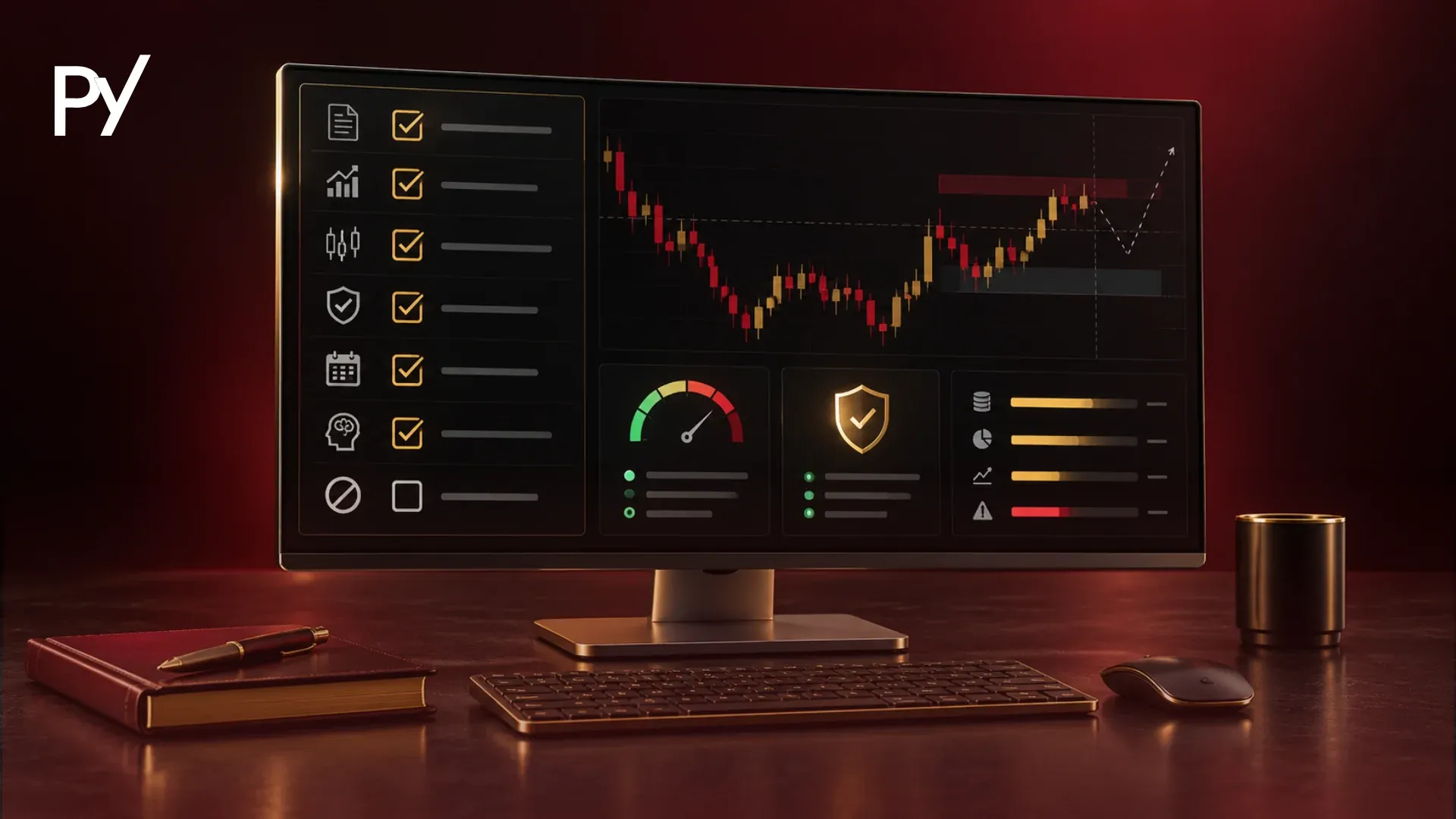
Day trading risk management in a funded account is the systematic control of exposure calculated against allowable drawdown limits rather than total nominal balance. By sizing positions according to stop-loss distance and enforcing hard daily loss caps, traders prevent catastrophic account breaches. This structured approach preserves equity and aligns execution with strict prop firm evaluation rules.
Day trading risk management is the systematic process of controlling position size, setting execution caps, and enforcing hard session loss limits to protect intraday capital from market volatility.
Most funded traders fail not because their strategies lack edge, but because they treat a prop account's nominal balance like cash equity. When you trade with a hard drawdown limit, standard retail risk rules break down immediately.
This guide explains how to recalibrate your position sizing math, enforce platform circuit-breakers, and protect your usable equity under strict prop firm rules.
What Is Day Trading Risk Management in Funded Trading?
Day trading risk management in a funded account is the practice of aligning every trade's exposure with the firm's specific drawdown and daily loss thresholds rather than total virtual balance.
When trading standard brokerage accounts, risking 1% on a $100,000 balance means risking $1,000. If your balance drops to $99,000, you still retain 99% of your working capital. However, prop firm evaluation challenges operate under entirely different mechanics.
On a $100,000 funded account with a 5% ($5,000) maximum allowable drawdown, your actual trading buffer is only $5,000. Taking a $1,000 risk on a single trade does not represent 1% of your available capital—it consumes 20% of your total allowable drawdown before your account is terminated.
Confusing nominal account value with usable drawdown capital is the primary trap that wipes out developing traders. Mastering the fundamentals begins with understanding that your risk exposure must always be calculated against your drawdown allowance, not the headline account size.
The Core Mechanics: Position Sizing and Drawdown Rules
Position sizing in day trading requires dynamic adjustment of contract or lot sizes based on stop-loss distance to ensure dollar risk remains constant across varying market conditions.
To survive strict prop limits, you must replace arbitrary lot sizing with fixed-fractional drawdown math. Instead of opening a standard 1.0 lot on every trade, your position size should fluctuate based on where your technical stop-loss must sit.
The position sizing formula for intraday contracts or currency lots is structured as follows:
If market volatility expands and your required stop-loss increases to 20 pips, your lot size must automatically contract to 0.125 lots to keep your total dollar risk capped at exactly $25.
Hard Bracket Orders vs. Mental Stops
Relying on mental stop-losses is one of the fastest ways to fail an evaluation. Intraday slippage, sudden news spikes, and emotional hesitation can turn a planned 10-pip loss into a 40-pip disaster. Professional risk management mandates using platform-level One-Cancels-the-Other (OCO) bracket orders.
When you submit an entry order, your protective stop-loss and profit target are generated simultaneously on the broker's server, removing human emotion from trade execution.
Why Risk Management Trumps Win Rate for Prop Traders
Risk management determines long-term trading longevity because statistical expectancy and asymmetric loss recovery dictate that a high win rate cannot overcome catastrophic drawdowns.
Many retail traders focus exclusively on achieving a 70% or 80% win rate. However, without strict risk asymmetry, a high win rate can still lead to complete account breach.
Consider a system with an 80% win rate that gains $100 on winning trades but risks $500 on losing trades due to loose stops. Over ten trades (8 wins, 2 losses), the system yields $800 in gains but loses $1,000, resulting in a net loss of $200.
Conversely, a system with a modest 40% win rate and a 1:2 Risk-to-Reward (R:R) ratio remains statistically profitable over time. Risking $100 to make $200 over ten trades (4 wins, 6 losses) produces $800 in total gains against $600 in total losses, leaving a net profit of $200.
Asymmetric Loss Recovery Math
Drawdowns do not recover linearly; they compound geometrically. If you lose 10% of your working capital, you require an 11.1% gain just to return to breakeven. If you lose 50% of your allowable drawdown buffer, you must generate a 100% return on your remaining capital simply to recover to your starting equity peak.
Daily Circuit Breakers
To prevent deep drawdowns, professional prop traders implement strict daily loss limits. A standard rule is setting a daily loss cap at 2 unit risks (e.g., stopping for the day if you lose $50 on a $25 per trade risk setup). Once that limit is hit, trading for the session ceases immediately.
4 Essential Risk Control Rules for Funded Accounts
Funded account risk control relies on enforcing automated loss caps, managing trailing limits, enforcing lot maximums, and setting hard session exit rules.
Hard Daily Loss Locks: Most professional trading platforms allow users to enable account lockouts or auto-flatten features. Once your floating or realized losses hit your predefined daily limit (typically 4%–5% of nominal account size), the platform locks execution permissions until the next session opens.
Trailing Drawdown Adjustments: Unlike static loss limits that remain fixed at your starting balance, trailing drawdowns track your equity peak in real-time. As your account balance grows, the drawdown floor moves upward. Once the trailing drawdown locks at your initial starting balance, your buffer stops rising, but you must remain mindful of realized vs. unrealized gains to avoid trailing into a breach.
Max Contract Caps: Set explicit contract or lot limits within your execution software settings. Restricting maximum execution size prevents accidental fat-finger orders or impulse trades that exceed risk limits.
The 3-Strike Session Rule: If you suffer three consecutive losing trades during a single trading session, step away from the charts. Consecutive losses usually indicate either unfavorable market conditions for your methodology or emerging psychological tilt.
Common Day Trading Risk Traps That Wipe Funded Accounts
Funded accounts are most frequently breached by sizing trades off nominal equity, averaging down into losing positions, and engaging in impulse revenge trading.
Trap 1: Sizing Off Account Nominal Balance: Treating a $100,000 evaluation account as if you have $100,000 of risk capital leads to aggressive lot sizing that breaches drawdown limits in just a few trades.
Trap 2: Averaging Down Into Losses: Adding contracts to a losing intraday position lowers your average entry price, but it exponentially increases your total exposure. If the market continues trending against you, a single trade can breach both your daily loss cap and maximum drawdown limit simultaneously.
Trap 3: Revenge Trading & Over-Leveraging: After taking a loss, the psychological urge to immediately recover capital often leads to doubling lot sizes or taking low-probability setups. Revenge trading bypasses risk management rules and is the single leading cause of single-session account failure.
Revenge trading often starts with a small, acceptable loss that triggers a desire to get back to breakeven before the market closes. Installing automated platform locks is the most effective way to protect your account when discipline breaks down.
Building a Sustainable Foundation
Mastering day trading risk management requires shifting your perspective from chasing rapid profits to preserving usable drawdown capital.By calculating position sizes based on allowable loss buffers, implementing hard daily loss limits, and eliminating revenge trading habits, you build a sustainable foundation for funded trading success.
Capital preservation ensures that you survive volatile market sessions and retain your funded status over the long term.
FAQ
How much should a day trader risk per trade on a funded account?
On a funded account, traders should risk no more than 0.5% to 1% of their allowable drawdown limit per trade—not their nominal account balance. For example, on a $100,000 account with a $5,000 maximum drawdown, a 0.5% risk equals $25 per trade. This conservative sizing protects your usable equity buffer during extended losing streaks.
What is the 1% rule in day trading and how do you calculate it?
The 1% rule states that a trader should never risk more than 1% of working capital on a single trade. In funded trading, this 1% is calculated against the maximum allowable drawdown cushion rather than the account balance. Position size is determined by dividing the allowable dollar risk by the product of stop-loss distance and point or pip value.
How do you calculate position size based on stop-loss distance?
To calculate position size, divide your maximum dollar risk per trade by your stop-loss distance multiplied by tick or pip value. If your maximum risk is $50 and your technical stop-loss requires a 10-pip risk on a pair where 1 standard lot equals $10 per pip, your position size is exactly 0.5 standard lots.
What is the difference between daily loss limit and maximum drawdown?
A daily loss limit is a session circuit-breaker that caps floating or realized losses within a single trading day, usually enforced by platform auto-flatten features. Maximum drawdown is the cumulative loss threshold across the life of the account that results in account breach. Daily loss limits act as early warning systems before approaching maximum drawdown boundaries.
What is a good risk-to-reward ratio for day trading?
A risk-to-reward ratio of at least 1:1.5 or 1:2 is recommended for day trading funded accounts. This ratio ensures positive statistical expectancy over time, allowing a trading strategy to remain overall profitable even if its win rate drops below 50%. Higher ratios provide an essential cushion against asymmetric drawdown recovery math.
How do you stop revenge trading after a losing trade?
The most effective way to eliminate revenge trading is by enforcing automated platform locks and setting a strict session loss cap, such as the 3-strike rule. Once two or three consecutive trades end in losses or your daily loss cap is reached, execution permissions are locked, forcing you to step away and reset psychologically.
Disclaimer
Disclaimer: This guide was written with AI assistance, reviewed for accuracy by the Proptary editorial team, and kept up to date. It's for education only — not financial advice. Prop trading and the financial markets carry a significant risk of loss, so consider your own situation and consult a licensed advisor before you trade.
Proptary editorial team independently reviews prop trading firms, verifies payouts, and explains the rules that decide who keeps an account. We disclose affiliate relationships and publish methodology for every score.