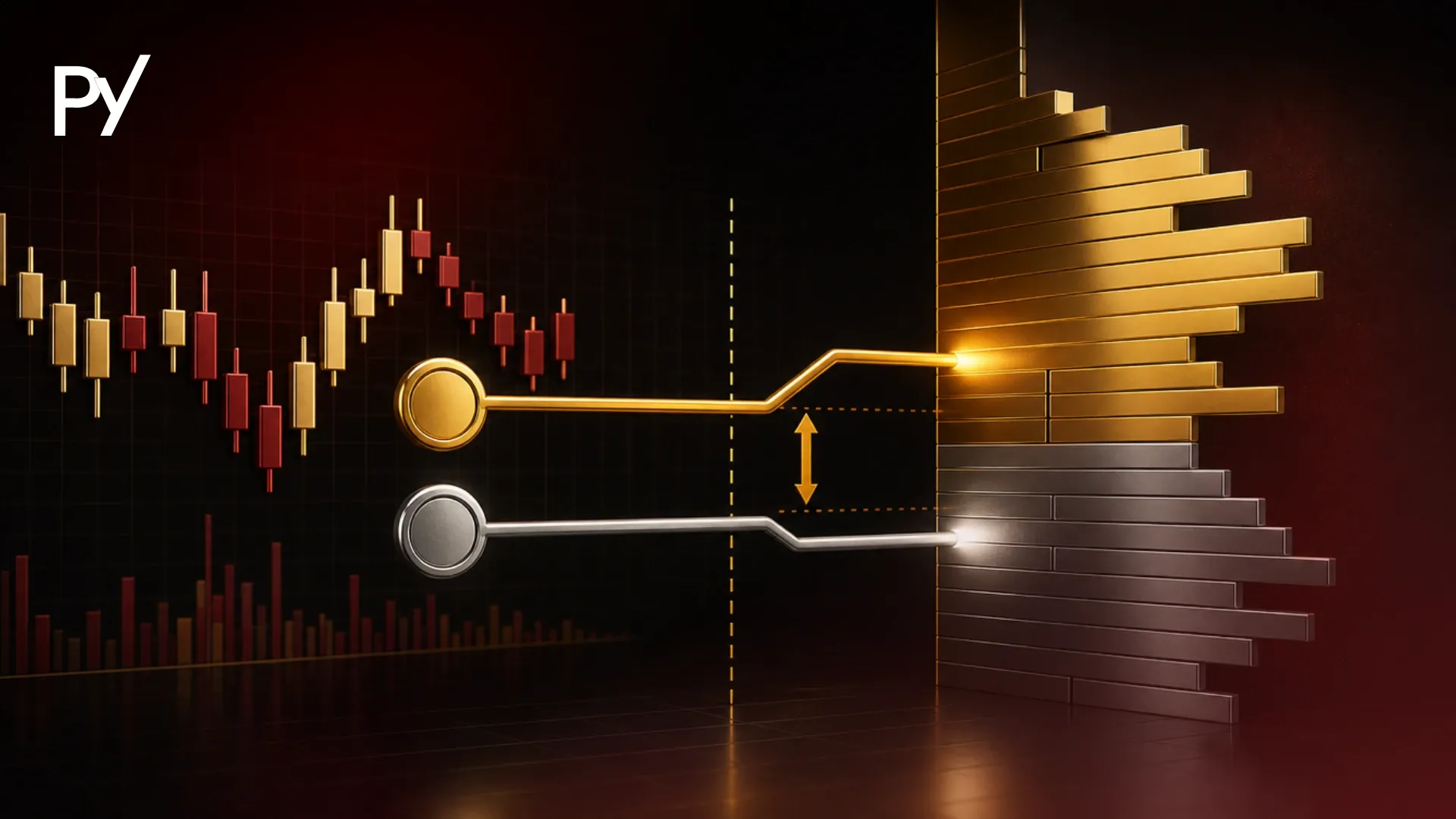
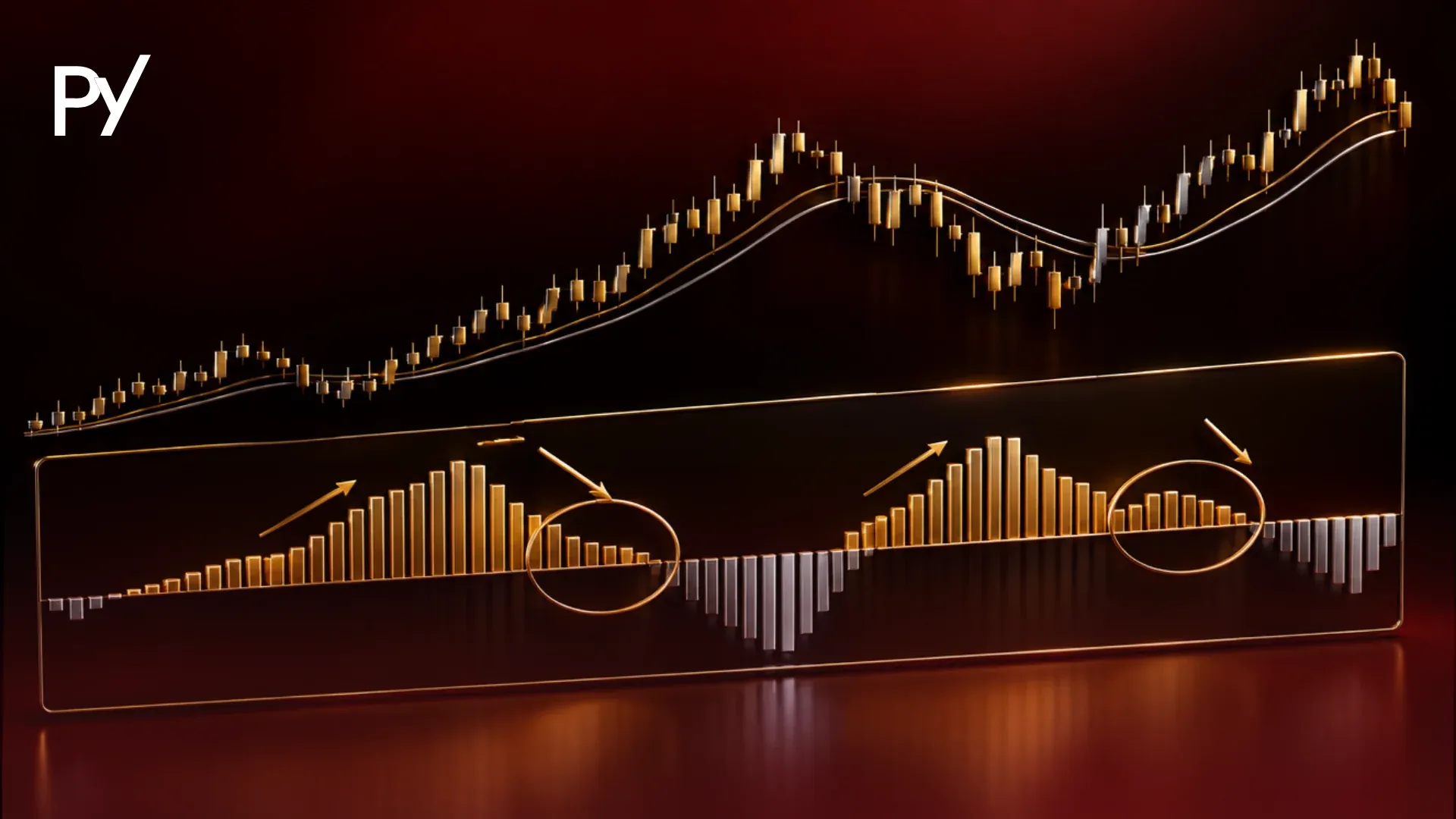
An inverse fair value gap (IFVG) is a three-candle price imbalance disrespected by aggressive order flow, causing its technical support or resistance role to flip. It is confirmed when a candle body closes decisively beyond the gap's outer boundary rather than wicking through.
In plain terms, a price zone that was expected to hold gets traded through, and it then works in the opposite direction.
Some traders fail prop challenges by taking standard gap retests directly into aggressive counter-flow, where slippage can push a trade past the daily drawdown limit. Understanding how a disrespected gap inverts allows you to capitalize on institutional order flow shifts rather than standing in their way. This guide details how to verify valid gap inversions, align them with structural context, and enforce strict position sizing under firm risk limits.
What Is an Inverse Fair Value Gap (IFVG)?
An inverse fair value gap—frequently referred to as an inversion fair value gap—occurs when an established price imbalance is disrespected by opposing order flow, causing its technical function to invert. Under standard Smart Money Concepts (SMC) and Inner Circle Trader (ICT) price action frameworks, a Fair Value Gap (FVG) represents a single-directional inefficiency created by rapid institutional buy or sell orders. Normally, traders expect price to return to this gap to rebalance liquidity before continuing in the original direction.
However, financial markets do not move in static patterns. When aggressive market participants enter with higher volume than the passive resting orders inside an FVG, price trades directly through the zone without stopping. Instead of acting as a turning point, the disrespected gap transitions into an inversion fair value gap.
Once inverted, the structural role flips:
Bullish FVG Failure → Bearish IFVG: A standard bullish FVG expected to act as demand is sliced downward by strong selling pressure. Once price closes below the lower boundary, the zone flips to become supply (overhead resistance).
Bearish FVG Failure → Bullish IFVG: A standard bearish FVG expected to act as supply is disrespected upward by strong buying pressure. Once price closes above the upper boundary, the zone flips to become demand (underlying support).
For prop firm traders, recognizing an inversion fair value gap prevents the mistake of fighting institutional momentum. Instead of repeatedly attempting to buy a falling support gap, you wait for the role reversal to establish clear resistance before entering aligned with the real market direction.
How an Inverse Fair Value Gap Works: The Mechanics
Understanding the mechanical lifecycle of an IFVG requires tracking candle closure rules, order flow displacement, and subsequent retest behavior across three distinct phases.
The 3-Candle Imbalance Setup
Every gap originates as a standard 3-candle sequence:
Candle 1: The initial candle establishing the outer edge of the price boundary.
Candle 2: An explosive, wide-range candle demonstrating institutional displacement.
Candle 3: The third candle whose high or low fails to overlap Candle 1, leaving an unmitigated open window (the FVG).
The Invalidation Candle (Body Close vs. Wick Poke)
The critical filter separating a true inversion fair value gap from a simple liquidity sweep is how price interacts with the outer boundary of Candle 1 and Candle 3.
If price merely wicks through the gap boundary and reverses, the original FVG remains intact; the wick simply swept resting liquidity. A valid IFVG is confirmed only when a candle body closes decisively beyond the far boundary of the gap. In ICT-style analysis, a candle body closure is read as a sign that passive limit orders inside the gap were consumed and market orders pushed price into new territory.
Consequent Encroachment Retest
After the body closure confirms the inversion, price frequently experiences a corrective pullback back toward the flipped zone. Traders focus on two specific entry reference points within the IFVG:
Near Boundary: The initial outer edge of the gap (the least aggressive entry).
Consequent Encroachment (CE): The exact 50% midpoint of the inverted gap range (a deeper entry offering tighter risk parameters).
When price pulls back into the CE level of a confirmed IFVG, many traders watch the zone for a re-entry, because former support may now act as resistance, or vice versa.
Standard FVG vs. Inversion Fair Value Gap: Core Differences
While both patterns utilize the same 3-candle imbalance geometry, their underlying order flow implications and structural rules are opposite.
Technical Metric
Standard Fair Value Gap (FVG)
Inversion Fair Value Gap (IFVG)
Primary Role
Direct continuation (support or resistance)
Role reversal (support ↔ resistance)
Price Action Trigger
Price respects and bounces off the 3-candle gap boundary
Price impulsively disrespects and closes through the gap boundary
Confirmation Standard
Respect of gap boundary via wicks or body bounces
Decisive candle body close beyond the opposite gap edge
Market Structure Context
Trend continuation within established direction
Trend acceleration, failed retrace, or structural reversal
Prop Firm Risk Profile
Low-to-moderate risk on trend-aligned retests
Lower risk when paired with sweeps; high risk on false wicks
Standard FVGs rely on passive liquidity holding the line to extend a trend. Conversely, an inversion fair value gap highlights structural failure—it marks the exact point where one side of the market was overwhelmed, signaling a transition in short-term control.
How to Confirm and Trade IFVG Setups Under Prop Firm Constraints
Trading an inversion fair value gap on a funded account requires systematic confirmation. Because prop firm rules punish abrupt drawdown spikes caused by entry slippage, never take an IFVG entry without multi-step alignment.
Step 1 — Identify the Initial Liquidity Sweep
A stronger IFVG setup rarely forms in middle-of-the-pack price action. Look for price to sweep key liquidity—such as previous daily highs/lows, equal highs, or session extremes—before the failure occurs. The sweep provides the fuel for the aggressive counter-move that breaks the existing FVG.
Step 2 — Confirm Structural Shift and Displacement
As price aggressively rejects off the liquidity sweep, verify that the expansion move creates strong displacement. This directional movement must align with broader institutional order flow principles outlined in market structure trading. The displacement leg must slice completely through an existing opposite-side FVG, closing a candle body beyond its outer threshold.
Step 3 — Mark the Inverted Zone and Wait for Retest
Once the candle body closes through the disrespected gap, outline the upper and lower boundaries of that gap. Do not chase price as it expands away. Place limit orders or set price alerts at the gap threshold or its 50% Consequent Encroachment midpoint.
Step 4 — Seek Micro-Structure Confirmation
To refine stop-loss placement on higher-leveraged prop accounts, drop to a lower timeframe (e.g., 1-minute or 3-minute chart) when price returns to the IFVG zone. Confirm an internal shift in momentum, applying change of character rules to validate that buyers or sellers are stepping in before executing your market entry.
Managing Prop Firm Drawdown with IFVG Setups
Passing and maintaining a funded account requires adapting trade execution to rigid daily loss limits and maximum trailing drawdown constraints. An IFVG setup offers tight, well-defined risk parameters when executed correctly.
Stop-Loss Placement
Because an IFVG represents a flipped level of support or resistance, price should not cross back over the far boundary of the inverted gap once mitigation occurs.
Aggressive Stop: Placed 1–2 pips beyond the far outer edge of the IFVG zone.
Conservative Stop: Placed beyond the recent swing high or swing low created during the displacement leg.
If price closes back inside or through the IFVG, the setup is invalidated immediately. Close the position manually rather than letting it hit a wider stop.
Position Sizing Strategy Under Prop Limits
Many prop firms set a daily loss limit, and the exact figure varies by firm and program, so check your firm's rules page before you size a trade. To ensure a single failing trade does not eat into your daily buffer, calculate lot sizes based on the monetary distance between your entry and the gap invalidation point:
Position Size (in lots) = (Account Balance × Risk %) ÷ (Stop Loss Distance in Pips × Pip Value)
If an IFVG zone is wide due to elevated news volatility, shrink your position size rather than widening your risk tolerance. Many traders keep risk per trade between 0.5% and 1.0% of the account, which leaves room to absorb several losing trades in a row before reaching a daily loss limit. The right number depends on your firm's rules.
Take-Profit Targets
Anchor your profit targets to objective market structure pools:
Target 1: The origin swing extreme created prior to the gap inversion (e.g., 1:2 risk-to-reward ratio (R:R) minimum).
Target 2: Unmitigated higher-timeframe FVGs or opposing sell-side/buy-side liquidity pools.
Common IFVG Traps That Blow Prop Firm Accounts
While the inversion fair value gap is a versatile price action tool, misapplying it under live prop firm conditions can quickly damage your account health.
The Low-Liquidity Wick Trap
A common mistake is treating a wick penetration as a valid inversion. During low-volume periods—such as the late Asian session or news releases—price can spike through an FVG, sweeping stop orders before pulling back into the original range. If the candle body does not close outside the gap, the FVG has not inverted. Taking entries on wick breaks leads to buying at local highs or selling at local lows.
Trading IFVGs Against High Timeframe Bias
An IFVG on a 1-minute or 5-minute chart is subordinate to higher timeframe (HTF) market structure. If the 4-hour chart is strongly bullish, a 1-minute bearish IFVG is likely a temporary counter-trend retracement rather than a permanent directional reversal. Taking short entries off lower-timeframe bearish inversions into higher-timeframe demand zones frequently results in stopped-out trades.
Overleveraging Failed Flips (FOMO Entries)
When a strong displacement leg breaks through an FVG, traders often experience fear of missing out (FOMO) and market-enter immediately at the extension peak. Because the distance to the logical stop-loss is now wide, overleveraging at the top of the move creates a large floating drawdown if price pulls back deeply into the Consequent Encroachment level before resuming. Always wait patiently for price to return to the inverted gap zone.
Key Takeaways for Trading the Inverse Fair Value Gap
The inverse fair value gap provides funded traders with a rules-based framework for identifying what many traders read as institutional order flow reversals and failed continuation setups. By requiring a decisive candle body close to confirm gap role reversals, aligning entries with liquidity sweeps, and executing pullbacks at Consequent Encroachment midpoints, you remove some of the guesswork from structure trading. Sizing positions from the inverted gap boundaries can help keep each trade's risk inside your firm's daily drawdown limit, though no setup removes the risk of loss.
FAQ
What is the main difference between a standard FVG and an Inverse FVG?
A standard Fair Value Gap relies on passive liquidity holding price as continuation support or resistance. An Inverse Fair Value Gap marks a structural failure where aggressive counter-directional orders trade completely through an established FVG, flipping its technical role so former support acts as new resistance or former resistance acts as new support.
Does a candle wick invert a Fair Value Gap, or is a body close required?
A candle body close is strictly required to confirm a valid Inverse Fair Value Gap. A wick poke beyond the boundary indicates a liquidity sweep of resting stop orders before price returns to its original trend. In contrast, a full candle body closure is read as a sign that passive liquidity was absorbed by market orders pushing into new structure.
What is the best stop-loss placement when trading an IFVG?
Conservative traders place stop-losses beyond the recent swing high or swing low created during the initial displacement leg. Aggressive traders place tight stops 1 to 2 pips beyond the far boundary of the inverted gap zone. If price closes back inside the inverted gap, the setup is invalidated and should be exited manually.
What is Consequent Encroachment in an Inverse Fair Value Gap?
Consequent Encroachment (CE) is the exact 50% midpoint of the inverted gap's price range. When price pulls back toward a confirmed IFVG, many traders treat the CE level as a key re-entry zone, which offers a deeper entry with a tighter stop-loss than entering at the outer boundary.
Why do Inverse Fair Value Gaps fail during trading?
Inverse Fair Value Gaps usually fail when traded against the higher-timeframe bias, during low-volume sessions, or immediately surrounding high-impact economic news. Expanded spreads during news events create false gap breaks on lower timeframes that collapse once normal order flow returns, trapping traders into premature entries.
Disclaimer
Disclaimer: This guide was written with AI assistance, reviewed for accuracy by the Proptary editorial team, and kept up to date. It's for education only — not financial advice. Prop trading and the financial markets carry a significant risk of loss, so consider your own situation and consult a licensed advisor before you trade.
Proptary editorial team independently reviews prop trading firms, verifies payouts, and explains the rules that decide who keeps an account. We disclose affiliate relationships and publish methodology for every score.