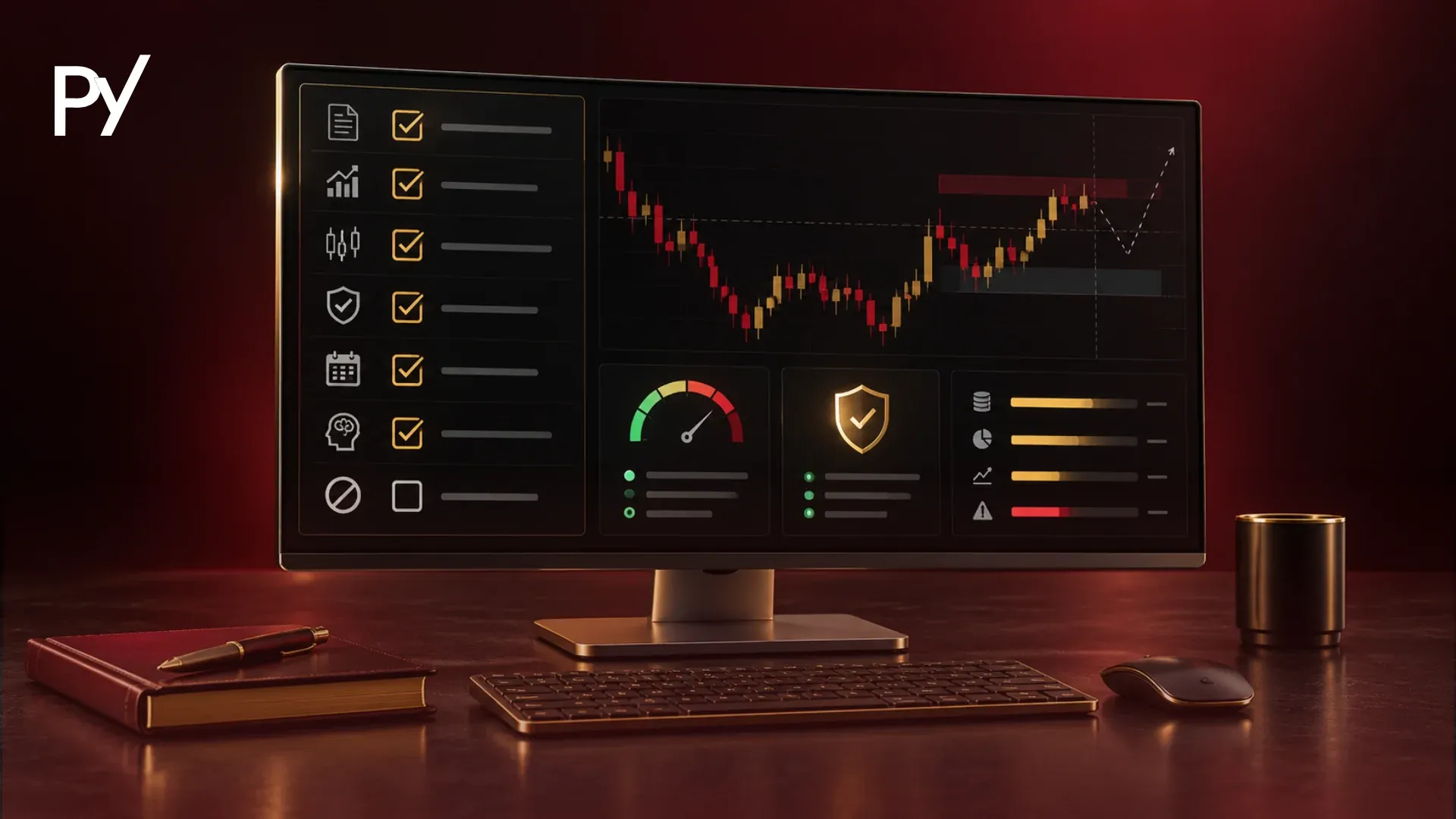

What Makes Day Trading Hard? The 90% Failure Rate Explained
Is day trading hard? Yes — it is exceptionally hard because it requires consistently executing probabilistic strategies against institutional competition and market friction under heavy emotional strain.
Day trading is inherently hard because you operate in a net-negative environment where transaction fees, bid-ask spreads, and execution slippage continually erode your profit margins.
Many traders jump in expecting quick financial freedom, only to face execution slippage, psychological burnout, and steep drawdowns. Understanding why most market participants fail is the first step toward long-term capital preservation. This guide breaks down the real statistical failure rates, cognitive barriers, and exact mechanical rules that make trading inside a funded account uniquely challenging.
A widely-cited 2020 academic study (Chague, De-Losso & Giovannetti, published via SSRN) using Brazilian CVM regulatory data found that 97% of persistent day traders lost money, consistent with other regulatory disclosures showing loss rates from roughly 74% to 95%.
Unlike traditional long-term investing, where market growth works in your favor, day trading requires extracting short-term profit from price fluctuations before costs eat away your edge. Every trade you enter incurs friction—commissions, exchange fees, and spread markups—meaning you start every position slightly in the red.
Furthermore, retail day traders do not operate in a vacuum. You are actively competing against high-frequency trading (HFT) algorithms, quantitative hedge funds, and institutional desks equipped with co-located servers, superior market data, and teams of PhD researchers. While retail traders rely on manual chart execution, institutional algorithms react to order flow changes in microseconds, exploiting liquidity gaps and front-running predictable retail stop clusters.
Put simply, day trading is hard because nearly every structural advantage — speed, data, and capital — sits with institutions, not retail traders.
Cognitive vs. Behavioral Barriers: Why Most Traders Lose
Most traders lose money not because technical analysis is hard to learn, but because human decision-making under stress directly conflicts with sound risk management.
The initial learning curve of technical analysis—understanding support and resistance, moving averages, or candlestick patterns—can be mastered in a matter of weeks. However, the true barrier is behavioral execution. When live money is on the line, human psychology introduces cognitive biases that sabotage trade management:
- Loss Aversion: The psychological pain of losing $500 feels twice as intense as the joy of making $500. This causes traders to hold losing positions, hoping the market turns around, while cutting winning trades prematurely.
- Revenge Trading: Re-entering the market immediately after a loss to "get money back," which usually leads to over-leveraging and catastrophic drawdowns.
- FOMO (Fear of Missing Out): Chasing extended candles late in a move, entering at terrible risk-to-reward ratios right before price retraces.
- Overconfidence Bias: Increasing position sizing during a temporary winning streak, mistaking a favorable market regime for skill.
This creates the execution gap: knowing what you should do according to your trading plan versus what you actually do when experiencing live drawdown.
Why Day Trading Is Harder Inside a Funded Account
Day trading inside a prop firm account is significantly harder than managing a personal brokerage account because rigid evaluation rules leave zero allowance for execution errors.
While trading personal capital allows you to weather temporary drawdowns as long as your account has margin, prop firm evaluation challenges enforce strict risk boundaries. Passing an evaluation phase requires generating a 6% to 10% profit target while staying within daily and total drawdown limits.
The specific rules that compound day trading difficulty include:
- Trailing Drawdowns: A trailing drawdown floor moves upward as your account balance or open equity reaches new highs. If your peak equity increases by $1,000, your drawdown floor rises by $1,000. However, once your account drops back toward that floor, it does not trail back down—locking you into a shrinking buffer.
- Daily Max Loss Limits: A single volatile economic news release or execution slip can push your daily loss beyond the 4% or 5% cap, triggering an instant account breach regardless of your historical win rate.
- Consistency Metrics: Many firms mandate that no single trading day can account for more than 30% to 50% of your total profit target, preventing traders from relying on lucky windfalls.
These constraints explain why prop evaluation pass rates are very low, and why maintaining a funded account over six months requires a far higher standard of risk discipline than standard retail trading.
Is Day Trading Harder Than a 9-to-5 Job?
Day trading is fundamentally harder than a traditional 9-to-5 job because it eliminates the predictable relationship between time invested and financial compensation.
In a traditional career, effort, hours worked, and task completion yield a guaranteed paycheck. In day trading, you can work eight hours of intense analysis, execute your setup flawlessly according to your plan, and still finish the day down $1,000 due to normal statistical distribution. The complete absence of guaranteed income creates intense psychological anxiety.
Traders often wonder is day trading worth it given the heavy mental demands. Unlike corporate roles where feedback is structured and mistakes can be remediated, financial markets deliver immediate monetary feedback. Managing isolation, continuous uncertainty, and performance pressure without a steady safety net requires high levels of emotional maturity.
How to Make Day Trading Manageable: The 4 Structural Pillars
You make day trading manageable by implementing mechanical risk guardrails that completely remove emotional discretion from your order execution.
To survive the learning curve and protect capital inside a funded account, build your trading around four operational pillars:
- Fixed Systemic Risk: Never risk more than 0.5% to 1% of your total account balance on a single trade. Using hard stop-losses on every trade ensures no single error destroys your equity base.
- Hard Daily Loss Limits: Establish a self-enforced circuit breaker. If you lose two trades in a session, close your platform for the day to prevent revenge trading.
- Process-Driven Journaling: Audit your execution rather than your P&L. Record whether you followed your entry, exit, and sizing rules rather than judging success purely on daily dollar returns.
- Prop-Specific Position Sizing: Calculate your position size based on your maximum allowable drawdown buffer rather than the account balance. If a $100,000 account has a maximum trailing drawdown of $5,000, your effective working capital is $5,000—not $100,000.
Common Mistakes That Guarantee Failure
Most trading accounts are destroyed by predictable behavioral traps rather than normal statistical market noise.
- Martingale Sizing: Doubling position size after a losing trade to break even quickly. This tactic guarantees an account breach during normal drawdown streaks.
- Strategy Hopping: Switching indicators or trading systems after three consecutive losses, never allowing a strategy with a statistical edge time to play out.
- Misinterpreting Drawdown Calculations: Failing to distinguish between static balance drawdown and live equity drawdown rules before opening positions.
Mastering Risk Before Chasing Capital
Day trading is exceptionally difficult because it demands absolute emotional control inside an uncertain, highly competitive financial environment. Adding prop firm constraints makes execution even tighter, forcing you to operate within narrow drawdown boundaries and strict consistency rules. Success requires shifting your focus away from making rapid profits and toward mastering risk control, mechanical discipline, and psychological fatigue.