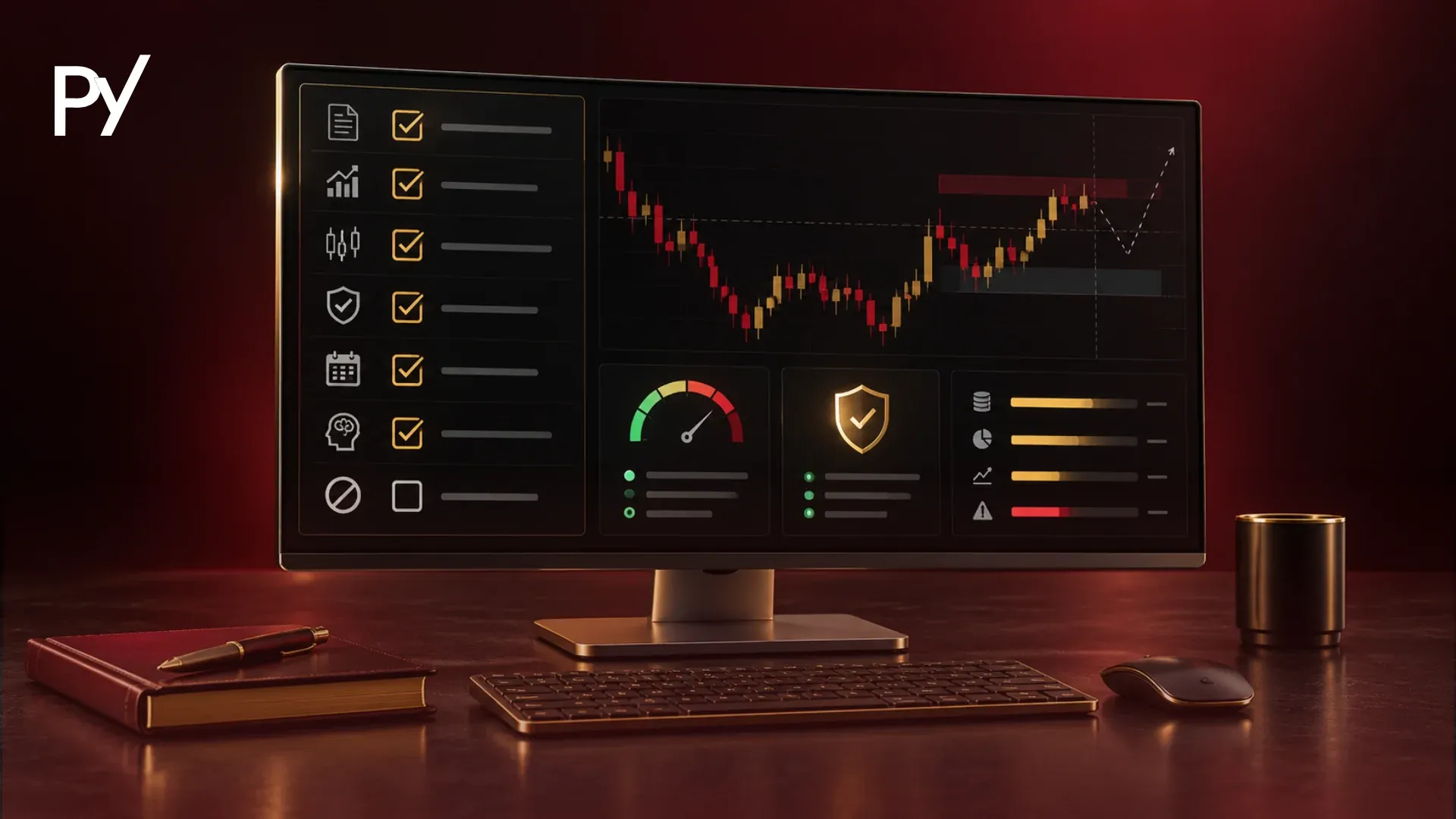
Swing trading risk management in a funded account involves calculating lot sizes based on technical stop-loss distance, limiting risk per trade to 0.5%–1.0% of equity. Traders must account for daily drawdown resets and trailing equity floors when holding positions across multiple days. Protecting capital against overnight gaps and swap fees ensures multi-day swing trades do not trigger automated account breaches.
Swing trading risk management in a funded account is the practice of controlling lot sizes, stop losses, and multi-day exposure to capture trend movements without breaching strict daily or maximum drawdown limits.
Holding positions over several days offers larger profit potential, but exposes your account to overnight market gaps, swap fee drag, and daily equity reset traps.
Understanding how floating profits alter drawdown thresholds is what keeps your funded account alive. This guide covers position sizing calculations, technical stop placement, and strategies for navigating prop firm holding rules across multi-day trades.
What Is Swing Trading Risk Management in Funded Accounts?
Swing trading risk management in a funded environment balances wider technical stop losses against narrow, non-negotiable account drawdown boundaries.
While retail traders managing personal capital only focus on overall account balance, funded traders operate under dynamic equity constraints. Prop firm rules enforce daily loss limits, maximum drawdown thresholds, and sometimes trailing equity locks that track peak floating profits.
When you hold trades across multiple sessions, a position moving in your favor can shift your drawdown floor upward before retracing, leaving you with less breathing room than when the trade opened.
Managing this risk requires aligning trade parameters with your firm's specific swing trading drawdown rules and understanding how floating equity interacts with daily account resets.
Position Sizing and Stop-Loss Placement for Swing Trades
Position sizing for swing trades requires calculating lot sizes directly from technical stop-loss distances rather than using fixed lot allocations.
Effective stop loss placement in swing trading relies on market structure—placing stops beyond recent swing highs, swing lows, or key technical support and resistance levels. To account for multi-day market noise, many traders use the Average True Range (ATR) indicator, setting stop losses at 1.5× to 2.0× the daily ATR value.
To execute accurate swing trade position sizing, apply the standard risk formula:
Pairing technical stops with a disciplined risk to reward ratio setup of at least 1:2 or 1:3 ensures that winning trades cover small, controlled losses. Knowing how to size positions for trailing drawdown keeps risk parameters consistent even when managing wider multi-day stops.
When transitioning from day trading to swing trading on a funded account, reduce your standard risk percentage. Wider stop losses require smaller lot sizes, which protects your daily drawdown budget if an open swing trade moves against you during volatile session overlaps.
The Prop Trading Multi-Day Traps: Overnights, Swaps, and Weekend Gaps
Multi-day swing positions subject funded accounts to three distinct operational hazards: daily equity reset shifts, overnight swap charges, and market gap slippage.
One of the riskiest mechanisms for swing traders is the daily drawdown reset. Most prop firms recalculate maximum daily loss at a specific server time, typically 00:00 GMT. If you carry a position with $2,000 in floating unrealized profit into the reset, that floating equity raises your baseline balance for the next day's daily loss limit.
If the trade retraces by $1,500 the following morning, the firm counts that $1,500 pullback as a daily loss—potentially breaching your daily drawdown threshold even though the overall trade remains profitable.
Additionally, overnight gap risk in prop firm accounts creates meaningful exposure during weekend holds. If market-moving news breaks while liquidity is closed, prices can open far past your technical stop loss.
Because stop-loss orders execute at the first available market price during a gap, slippage can breach your maximum loss limit instantly. You must verify whether your account tier permits weekend holding before leaving positions open over Saturday and Sunday.
Personal Account vs. Funded Account Swing Risk
Managing a personal retail trading account differs fundamentally from managing a funded prop account due to rigid drawdown constraints and strict operational rulebooks.
In a personal account, you can absorb drawdown as long as your margin holds, and open equity fluctuations do not trigger automated account closures. In contrast, prop firm accounts enforce strict rules that monitor both balance and real-time floating equity.
Risk Parameter
Risk Parameter
Funded Prop Account
Drawdown Basis
Static balance / total capital
Daily limit + trailing or static max limit
Overnight Gap Exposure
Trader absorbs equity loss
Slippage beyond max limit breaches account
Position Sizing Basis
Account balance & leverage
Available drawdown buffer & equity resets
Weekend Holding Rules
Unrestricted on all brokers
Firm-dependent; often requires specific account types
Swap & Rollover Drag
Deducted from account balance
Reduces floating equity toward daily loss floors
3 Costly Swing Trading Risk Mistakes That Wipe Funded Accounts
Funded swing traders frequently fail by mismanaging floating equity, stacking correlated market exposure, and ignoring news holding restrictions.
Trailing Equity Traps: Allowing a swing trade to run deep into unrealized profit without securing gains, causing the trailing drawdown floor to lock at peak equity. When the trade pulls back, the account hits the locked loss floor.
Correlated Exposure Overflow: Opening simultaneous swing trades on EUR/USD, GBP/USD, and AUD/USD under the belief that risk is diversified. Because these assets correlate heavily against the US Dollar, a single market move effectively triples account exposure.
Ignoring High-Impact News Events: Leaving swing trades open through central bank interest rate decisions or Non-Farm Payroll (NFP) reports without checking news-holding rules. Breaking a firm's news trading window or failing the firm consistency rule can lead to payout forfeiture or account termination.
Keeping Your Funded Capital Secure
Swing trading risk management in funded accounts requires aligning technical stop losses with strict account drawdown constraints. Success depends on calculating lot sizes from ATR-based stops, accounting for daily equity reset mechanics, and preventing correlated trade exposure.
By respecting overnight gap risks and managing floating gains conservatively, swing traders can capture large trend moves while keeping funded capital secure.
FAQ
How much risk should you take on an individual swing trade in a funded account?
Most funded traders risk between 0.5% and 1.0% of total account equity per swing trade setup. Keeping risk within this range accommodates wider technical stop losses required for multi-day market volatility while protecting the account against sudden daily drawdown resets or consecutive losing trades.
How do you calculate the exact position size for a swing trade?
Position size is calculated by dividing your dollar risk amount by your stop-loss distance multiplied by pip value. For instance, risking $500 on a 100-pip EUR/USD stop-loss ($10 per pip per lot) results in a position size of 0.50 standard lots ($500 / (100 x $10)).
What is the most effective stop-loss strategy for multi-day swing trading?
Using Average True Range (ATR) paired with key technical structure levels is widely considered the best swing stop-loss strategy. Placing stops at 1.5x to 2.0x the daily ATR beyond swing highs or lows provides sufficient breathing room while maintaining a clear technical invalidation point.
Can you hold swing positions over the weekend in prop firm accounts?
Weekend holding rules vary significantly depending on the prop firm and account model. While swing-specific or evaluation accounts often allow weekend holding, standard or instant accounts may require closing all trades before the Friday market closes to eliminate unmanageable weekend gap slippage.
How do prop firm daily drawdown rules impact open swing trades?
Prop firm daily drawdown resets recalculate maximum allowable losses based on floating equity or closed balance at server midnight. If an open swing trade carries unrealized profit into the reset, that higher equity floor becomes the benchmark, making pullbacks count against the new day's loss limit.
Disclaimer
Disclaimer: This guide was written with AI assistance, reviewed for accuracy by the Proptary editorial team, and kept up to date. It's for education only — not financial advice. Prop trading and the financial markets carry a significant risk of loss, so consider your own situation and consult a licensed advisor before you trade.
Proptary editorial team independently reviews prop trading firms, verifies payouts, and explains the rules that decide who keeps an account. We disclose affiliate relationships and publish methodology for every score.