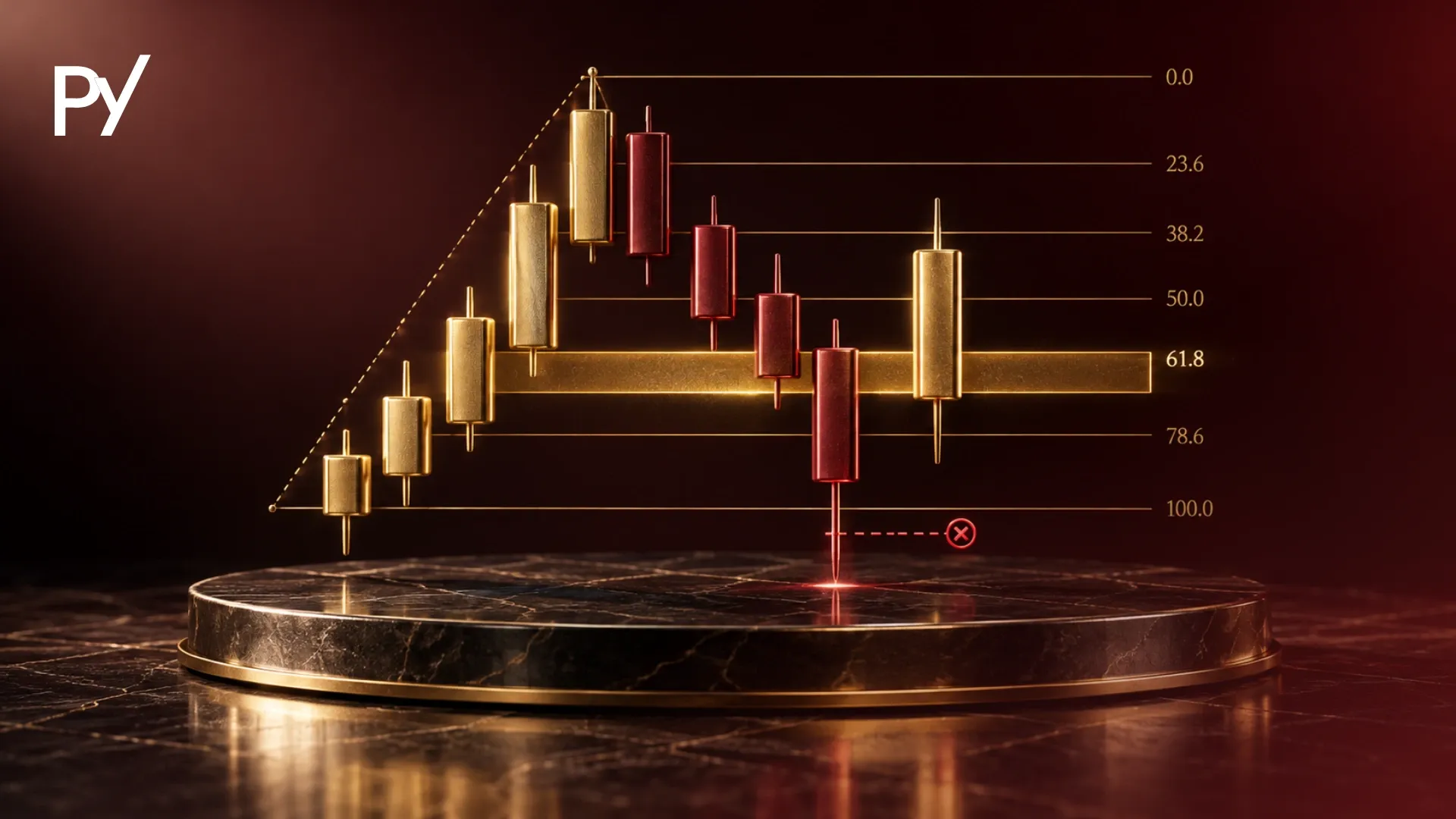
The three white soldiers candlestick pattern is a three-candle bullish reversal signal indicating institutional order absorption following a downtrend. Each consecutive candle opens within the previous real body and closes near its high with small wicks. Funded traders should enter on limit pullback orders rather than chasing market momentum to protect daily drawdown limits.
The three white soldiers candlestick pattern is a three-candle bullish reversal formation characterized by consecutive long green candles that open within the previous candle's real body and close near their highs.
For funded traders, seeing three consecutive expansion candles often triggers intense fear of missing out. However, entering at the close of the third candle exposes your account to sharp mean-reversion pullbacks that can instantly trigger daily drawdown limits or lock trailing drawdown floors against open equity.
This guide breaks down pattern mechanics, structural validation rules, and position-sizing strategies to protect your funded account.
What Is the Three White Soldiers Candlestick Pattern?
The three white soldiers candlestick pattern is a multi-bar bullish reversal structure that signals a complete transition from seller dominance to aggressive institutional buying at key chart levels.
When this pattern forms after a prolonged downtrend or a deep structural pullback, it reflects a decisive shift in market sentiment. Rather than a brief short-covering bounce, the pattern represents systematic order absorption where buyers actively bid up prices across three continuous trading sessions.
Structural Identification Checklist
Prior Trend: Must form after a clear, sustained downtrend or a technical pullback into a higher-timeframe demand zone.
Candle 1 (The Reversal Spark): A strong bullish candle that halts prevailing downward price action and closes back above minor intraday resistance.
Candle 2 (The Momentum Driver): Opens within the real body of Candle 1 and expands upward, establishing a clear higher high and higher low.
Candle 3 (The Expansion Confirmer): Opens within the real body of Candle 2 and closes near its extreme high, solidifying total buyer control.
Wick Mechanics: Upper shadows must remain small or non-existent, proving that buyers maintain firm control into the session close.
How Three White Soldiers Function in Live Market Conditions
In live market conditions, three white soldiers operate by systematically clearing resting sell orders across successive resistance levels, signaling that institutional buyers are absorbing supply.
Understanding how this pattern integrates with broader candlestick patterns helps you distinguish between genuine institutional accumulation and temporary liquidity traps.
Market Psychology and Order Flow Mechanics
When price declines into a high-timeframe demand area, institutional market participants begin accumulating long positions. Candle 1 represents the initial absorption phase, where large buy limits absorb heavy retail selling pressure.
As Candle 1 closes high, short traders begin placing stop-loss orders above immediate swing highs. Candle 2 triggers these buy-stops, accelerating upward velocity as forced short covering combines with new momentum buying.
By Candle 3, aggressive market orders sweep remaining resting liquidity. This creates a strong upward expansion but leaves price severely stretched away from value.
Volume and Technical Confluence Rules
Volume Expansion: Trading volume should ideally increase across each consecutive candle, validating expanding institutional participation.
RSI Momentum Recovery: Relative Strength Index (RSI) typically crosses upward from oversold territory (below 30) during Candle 1 and establishes above the 50 mid-line by Candle 3.
Higher-Timeframe Support: The setup carries high statistical validity only when forming at verified daily or 4-hour support zones — not in the middle of a consolidating range.
The Overextension & Trailing Drawdown Trap for Funded Traders
The three white soldiers pattern presents a dangerous trap for funded traders because three consecutive large expansion candles leave price severely overextended from key moving averages, exposing equity to sharp pullbacks.
The Trailing Drawdown Equity Lock
Many prop firms utilize trailing drawdown models that track your account's peak high-water equity. If Candle 3 causes your open equity to surge to a new high, the firm's trailing drawdown floor immediately locks higher.
If price then undergoes a natural 50% retest across those three large expansion candles, your open balance drops back down. Even if your trade remains structurally valid and hasn't hit its technical stop-loss, your equity can breach the newly locked drawdown floor, resulting in an instant account termination.
Managing Stop-Loss Distance and Lot Sizing
Placing a valid technical stop-loss below the low of Candle 1 across three wide expansion candles creates a large point or pip distance. If you use standard lot sizes without accounting for this wide distance, a single failing setup will breach your account's max daily loss limit.
Suppose you manage a $100,000 funded account with a maximum daily risk rule of 1% ($1,000).
Standard Entry Stop Distance (20 pips): Position size = 5.00 lots ($1,000 max risk ÷ $200 per pip value).
Three White Soldiers Stop Distance (60 pips): Position size = 1.66 lots ($1,000 max risk ÷ $600 per pip value).
Traders who fail to reduce position sizes when trading wide three-candle structures risk exceeding daily drawdown limits on a single market retracement.
Trading Three White Soldiers on a Funded Account: Execution Strategies
Successfully trading the three white soldiers pattern on a funded account requires disciplined entry timing — specifically utilizing limit orders on pullbacks or lower-timeframe confirmations rather than aggressive market chasing.
Conservative Retest Entry (Recommended for Prop Accounts)
Instead of executing a market buy at the close of Candle 3, apply a conservative limit order framework:
Draw a Fibonacci retracement — a charting tool that maps likely pullback zones between a swing low and swing high — across the entire range from Candle 1's low to Candle 3's high.
Identify the 50% to 61.8% retracement zone, or locate any Fair Value Gap (FVG) left inside Candle 2.
Place a buy limit order within this retest zone.
Position your stop-loss safely below the structural low of Candle 1.
Benefit: Reduces your stop-loss distance by half, improves the risk-to-reward (R:R) ratio, and prevents open equity drawdown from touching account drawdown limits.
Pattern Structural Comparison
Feature
Three White Soldiers
Bullish Engulfing
Candle Count
3 consecutive long bullish candles
2 candles (1 bearish, 1 larger bullish)
Development Speed
Multi-period momentum expansion
Rapid single-period reversal
Average Stop Distance
Wide (spans 3 full expansion bodies)
Moderate (spans 1–2 candles)
Retest Probability
High (frequently retests Candle 2/3 body)
Moderate (retests engulfing open/midpoint)
Prop Drawdown Risk
High overextension & trailing lock risk
Moderate risk; easier position sizing
Optimal Entry Mode
Retest limit order at FVG or 50% range
Market close or minor pullback entry
Common Failure Modes and Mistakes to Avoid
The three white soldiers pattern fails most frequently when it forms directly into higher-timeframe resistance zones or when individual candle bodies exhibit shrinking real ranges and expanding upper wicks.
The Advance Block Exhaustion Trap: If Candle 2 and Candle 3 show progressively smaller real bodies with long upper wicks, the structure is an "advance block" rather than true soldiers. This indicates that overhead supply is actively overpowering buyers.
Liquidity Sweeps Into Major Resistance: Institutional algorithms frequently generate three apparent expansion candles into a major daily resistance level to lure retail traders into buying breakouts, providing liquidity for institutional short positions.
Ignoring the Inverse Warning Signal: When a three white soldiers setup fails to break resistance and aggressively turns down, it often forms an inverse three black crows candlestick pattern, leading to rapid downside liquidations.
Over-Leveraging Wide Stops: Executing full lot sizes without adjusting for the wide stop-loss distance across three long candles.
Always cross-check the economic news calendar before entering on a completed three white soldiers pattern. High-impact news releases can instantly invalidate technical candlestick setups within seconds due to severe spread widening and slippage. If three white soldiers complete right before major news, cancel your limit orders.
Identifying Aggressive Buying Momentum
The three white soldiers candlestick pattern is a potent indicator of aggressive buying momentum and institutional trend reversal. For funded traders, achieving consistency with this pattern requires managing overextension risk through strict position sizing and waiting for high-confluence pullback entries.
By protecting your equity curve against sharp mean-reversion pullbacks, you safeguard your account balance while positioning for sustained upward moves.
FAQ
What does the three white soldiers pattern indicate?
The three white soldiers pattern indicates a clear sentiment shift from seller exhaustion to aggressive bullish accumulation. It reveals that institutional buyers are systematically absorbing supply across three consecutive trading periods, driving prices higher and clearing overhead resistance levels after a sustained decline or pullback.
How accurate is the three white soldiers candlestick pattern?
While three white soldiers signal strong momentum, accuracy depends entirely on market context. When forming at high-timeframe demand zones with rising volume, the pattern has high technical reliability. However, executing market entries on the third candle close without waiting for a retest often exposes traders to sharp mean-reversion pullbacks.
Where should you place a stop-loss when trading three white soldiers?
The standard technical stop-loss is placed below the lowest point of the first candle in the pattern. However, because three expansion candles span a wide price distance, prop traders must recalculate position sizes downward to ensure total dollar risk remains strictly within account drawdown limits (typically 1% or less).
What is the difference between three white soldiers and bullish engulfing?
A bullish engulfing pattern consists of two candles where a single large green body completely covers the previous red body, representing a rapid short-term reversal. Three white soldiers develop across three consecutive expansion periods, indicating sustained multi-bar momentum with a wider total price range and higher probability of a post-pattern pullback.
Why do three white soldiers fail?
Three white soldiers fail primarily when they form directly into major higher-timeframe supply zones, turning the expansion into a liquidity sweep for institutional sellers. The pattern also fails when candle bodies shrink while upper wicks expand (advance block), indicating emerging overhead supply and exhaustion rather than genuine buying power.
Disclaimer
Disclaimer: This guide was written with AI assistance, reviewed for accuracy by the Proptary editorial team, and kept up to date. It's for education only — not financial advice. Prop trading and the financial markets carry a significant risk of loss, so consider your own situation and consult a licensed advisor before you trade.
Proptary editorial team independently reviews prop trading firms, verifies payouts, and explains the rules that decide who keeps an account. We disclose affiliate relationships and publish methodology for every score.