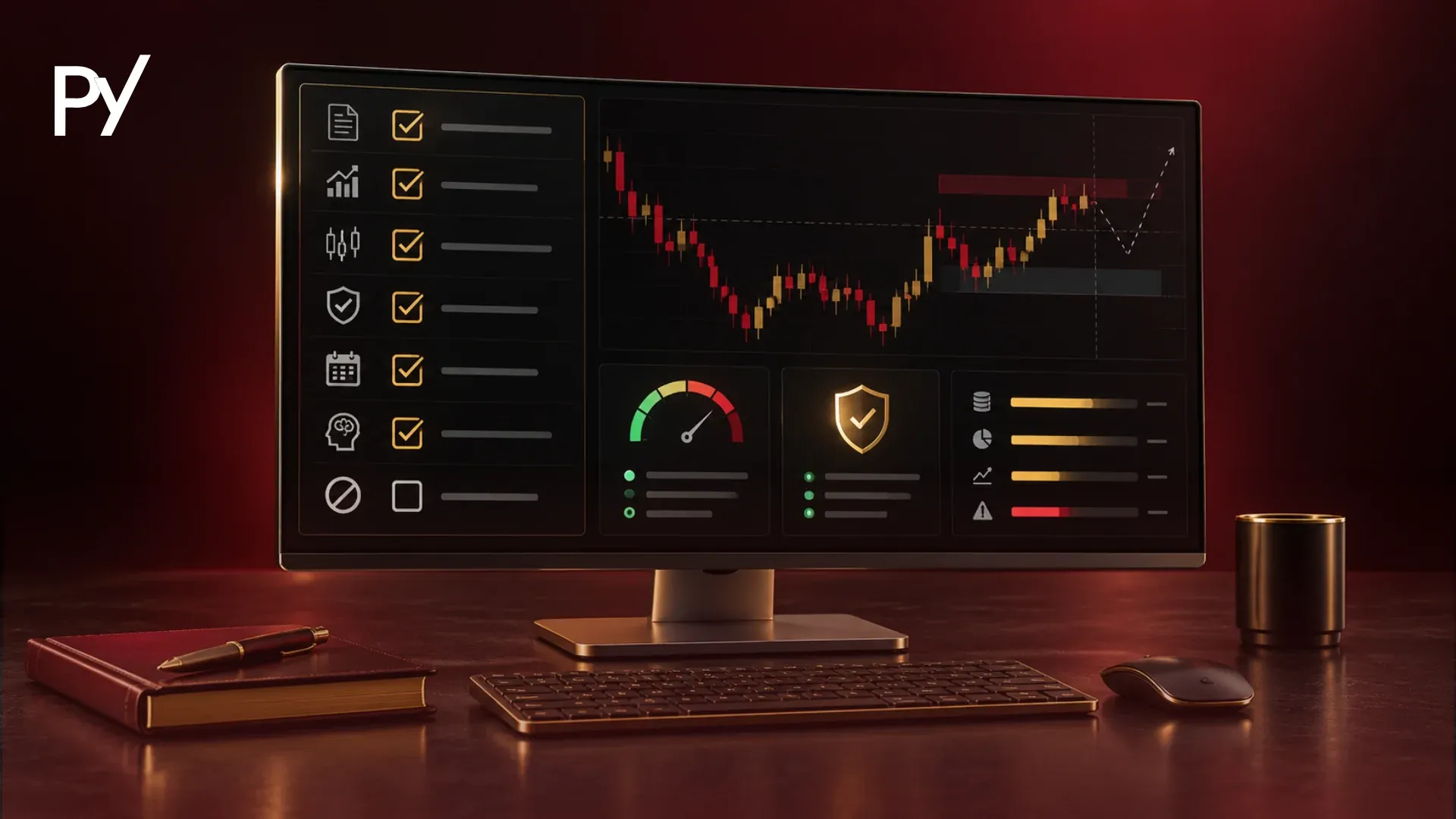
Trading psychology is the collection of cognitive processes, emotional triggers, and behavioral habits that dictate how a trader executes decisions under market uncertainty and financial risk.
While trading personal capital allows flexible timelines, evaluation accounts introduce firm-enforced drawdown limits, strict profit targets, and trailing loss parameters that meaningfully raise performance pressure. When fear of breaching a rule overrides systematic rules, execution breakdowns follow.
Building psychological resilience inside a funded account requires understanding how cognitive biases interact with firm mechanics and establishing hard behavioral guardrails.
What Is Trading Psychology in Funded Trading?
Trading psychology in funded trading refers to the mental discipline required to execute a systematic strategy while operating within rigid, firm-enforced risk parameters. Unlike trading a personal brokerage account where you set your own risk tolerance, prop firm evaluation challenges enforce hard rules that terminate account access the moment a threshold is crossed.
Developing your core trading skills requires distinguishing between cognitive biases and emotional triggers:
- Cognitive Biases: Systematic errors in thinking that distort decision-making. Examples include the disposition effect (cutting winners early while holding losers) and recency bias (overweighting the outcome of your last three trades).
- Emotional Triggers: Impulsive psychological reactions driven by immediate market stimuli, such as fear of missing out (FOMO) during a breakout or anger following a slippage fill.
In personal trading, an emotional mistake might result in a drawdown you can wait out over several months. In a funded account, that same mistake often triggers a daily loss limit breach, instantly liquidating the account and forfeiting your evaluation fee.
The Psychological Pressure of Prop Firm Mechanics
Prop firm mechanics like daily loss limits, trailing drawdown locks (drawdown ceilings that ratchet tighter as account equity grows), and time-sensitive evaluation targets compress psychological pressure by turning standard market retracements into existential account threats.
When a firm sets a 4% daily drawdown limit, a normal statistical cluster of losing trades becomes a high-stress scenario. This environment creates a distinct psychological conflict between loss aversion and evaluation constraints:
Loss aversion—the well-documented behavioral finding that losses tend to feel more painful than equivalent gains feel rewarding—becomes dangerous near drawdown boundaries.
As price approaches a daily loss limit, traders often remove stop-losses or double down, rationalizing that taking a realized loss guarantees an account breach, whereas holding gives the trade a chance to recover. This irrational behavior converts manageable losses into total account forfeitures.
Many traders fail evaluations not because they lack technical edge, but because they treat daily drawdown limits as target allocations rather than absolute structural walls. Treating a 5% limit as room to maneuver leads to over-leveraging when a position moves adversely.
Emotional Trading vs. Systematic Execution
Emotional trading occurs when impulsive feelings dictate order placement, whereas systematic execution relies on pre-defined, rule-based entries and risk allocations regardless of recent trade outcomes. Transitioning from impulsive decisions to a disciplined trading mindset requires recognizing when emotion has hijacked your process.
Common manifestations of emotional execution include:
- Revenge Trading: Opening immediate, oversized positions following a loss to instantly recover lost equity before the session ends.
- Moving Stop-Losses: Shifted stop orders further away from entry as price approaches them to avoid realizing a loss.
- Over-Leveraging: Increasing lot size beyond historical position-sizing parameters to hit profit targets prematurely.
To counter these patterns, you must separate strategy failure from execution failure. A strategy failure occurs when market conditions do not align with your edge, resulting in calculated losses within your plan parameters. An execution failure occurs when you violate position sizing, enter outside your rules, or tamper with active orders.
Practical Trading Psychology Tips for Forex and Futures Traders
Practical forex trading psychology relies on pre-session routines, strict daily stop-loss rules, and emotional tracking to prevent behavioral fatigue during volatile market conditions. Because forex and futures markets operate with high liquidity and extended trading hours, constant exposure increases cognitive fatigue.
Implementing effective trading psychology tips requires mechanical rules that interrupt emotional impulses:
- Enforce Hard Daily Circuit Breakers: Define a personal daily loss threshold at 50% of the firm's hard limit. If the firm allows a $2,000 daily loss, stop trading for the day if you lose $1,000.
- Maintain a Behavioral Journal: Log your internal state (e.g., calm, anxious, frustrated) alongside entry prices, execution quality, and setup types. Patterns will reveal specific emotional states that correlate with execution mistakes.
- Implement Post-Win Cooling-Off Periods: Require a mandatory 30-minute break after a major winning trade to prevent overconfidence bias from inflating your next position size.
- Decouple Self-Worth from Payouts: View evaluation challenges as operational expenses and trading capital as statistical units rather than personal money.
Common Psychological Traps That Breach Funded Accounts
Funded accounts are most frequently breached by predictable behavioral traps, including lot-size compounding during drawdowns and risk expansion immediately following a payout distribution.
The "One-Trade Recovery" Trap
After incurring a loss that consumes 65% of your daily allowance, the impulse to increase position size on the next setup to recover back to breakeven in a single trade is severe. This tactic ignores statistical probability and usually results in hitting the remaining drawdown limit on the subsequent loss.
For example, a trader with a $50,000 evaluation account and a $2,000 daily loss limit takes two early losses totaling $1,300. With $700 of allowance remaining, they widen their position size on the next trade to "make it back in one shot." The trade reverses, the account breaches its daily limit, and the evaluation resets to zero—a single oversized trade undoing three weeks of disciplined execution.
Overconfidence Post-Payout
Achieving a funded account or receiving an initial profit split often triggers dopamine rushes that degrade risk awareness. Traders frequently increase leverage or trade secondary, lower-quality setups immediately after a payout, leading to rapid drawdowns on newly funded capital.
Hesitation Near Profit Targets
As an account approaches an evaluation profit target (e.g., 8% or 10%), fear of giving back gains can cause traders to close winning positions prematurely or hesitate on valid entries. This alters the risk-to-reward mechanics of the strategy, dragging out the evaluation phase unnecessarily.
Building Psychological Discipline
Sustained performance in funded trading depends on establishing systematic mechanical guardrails that suppress cognitive biases under drawdown pressure. Strategy and technical analysis provide the entry framework, but psychological discipline dictates whether an account survives drawdown cycles to reach consistent payouts.